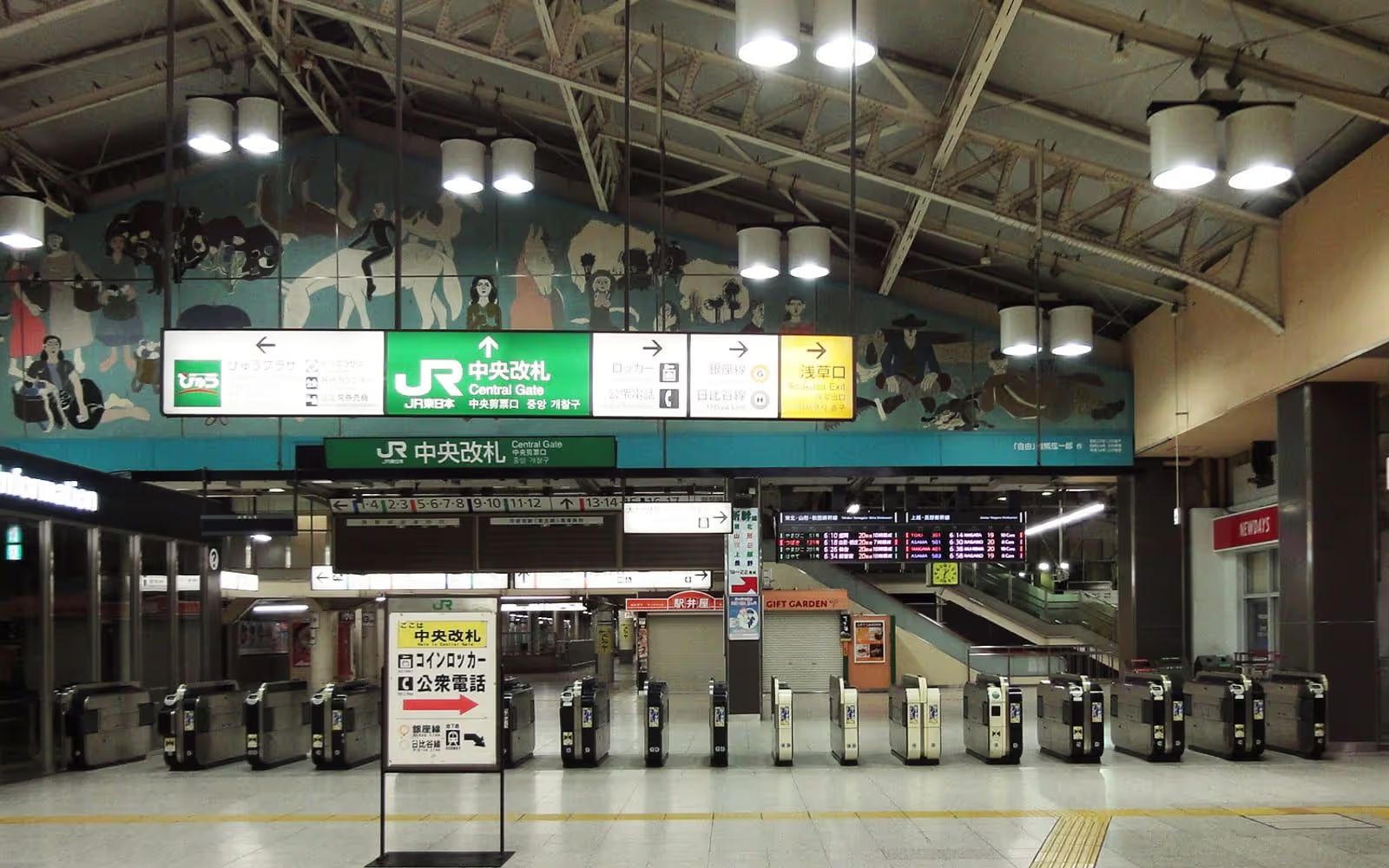
This photograph shows a comparable environment. It is not a photograph of this deployment — Ayonix has not released project photography for publication.
The business problem
Access cards fail in a specific and well-understood way: they record a credential rather than a person. A card can be lost, left at home, lent to a colleague or copied, and every one of those events costs something — a replacement, a reception queue, or an audit trail that records the wrong answer.
For an organisation with several offices, the aggregate cost is not in any one of those events but in the steady administrative load of issuing, replacing and revoking credentials.
The environment
ITOCHU Techno-Solutions Corporation (CTC) office entrances, in Japan.
What was deployed
In 2016, CTC adopted Ayonix FaceID across its offices to replace RFID access cards. The goal was straightforward: give employees faster, contactless entry while reducing the operational cost and inconvenience of lost and replacement cards.
CTC deployed Ayonix Face Recognition at its office entrances using iPads as facial-authentication terminals. As an authorised employee approaches the gate, the system verifies their identity in real time, unlocks the door and enables hands-free entry.
Why the terminal choice matters
Using a tablet as the capture terminal is a design decision with consequences worth noting, because it is the kind of detail that determines whether a deployment works:
- The camera sits at a known, fixed distance and angle from the person, which removes most of the capture-geometry uncertainty that ceiling-mounted cameras introduce.
- The person is looking at the terminal, which removes the pose problem entirely — people approaching a door look at the door, and a terminal at the door is where their face already is.
- The terminal provides its own consistent lighting conditions relative to the face, which is the variable that most often breaks an entrance deployment lit by a glass frontage.
These are the reasons a terminal deployment is usually easier to make work than a corridor-camera deployment, and they are worth understanding before choosing between the two.
The outcome, as far as it can be stated
CTC published its own announcement about the deployment in 2020, four years after adoption — which is itself a data point about the deployment continuing.
No headcount, door count, error rate or cost saving is published here, because none has been released for publication. A percentage reduction in card replacements would be more persuasive and would not be verifiable.
What this case does and does not establish
It establishes that a named enterprise customer deployed Ayonix face recognition for office access control using tablet terminals, and continued to reference it publicly four years later.
It does not establish anything about performance, scale or cost, and it should not be read as doing so. For referenceable detail beyond this, ask during procurement.
Next step
Discuss a comparable deployment
Bring the environment, the population and the decision the system has to make. The first conversation covers capture geometry, the exception path and how success would be measured — not a product pitch.