Ayonix Face Recognition

In short

Face recognition succeeds or fails on capture geometry: pixels across the eyes at the point people actually pass, mounting height and angle, standoff distance, lighting direction and subject movement. This guide covers each, and what good placement still cannot fix.

Measure at the capture point, not the frame

Almost every camera specification in this field is quoted for the whole frame: resolution, field of view, megapixels. None of that tells you what matters, which is how many pixels land on a face at the position where a person actually stands when the system has to make a decision.

The measurement takes a morning. Stand where a person stands. Capture a still. Count the pixels across the eyes. That number is the ceiling on everything downstream, and it is the one figure most often estimated rather than measured — usually optimistically.

This page deliberately does not publish a pixel threshold. A number quoted without the algorithm, the lighting, the pose and the matching mode would be wrong for some deployments and misleadingly reassuring for others. Measure yours and have the image assessed; that answers the question for your site rather than for an average one.

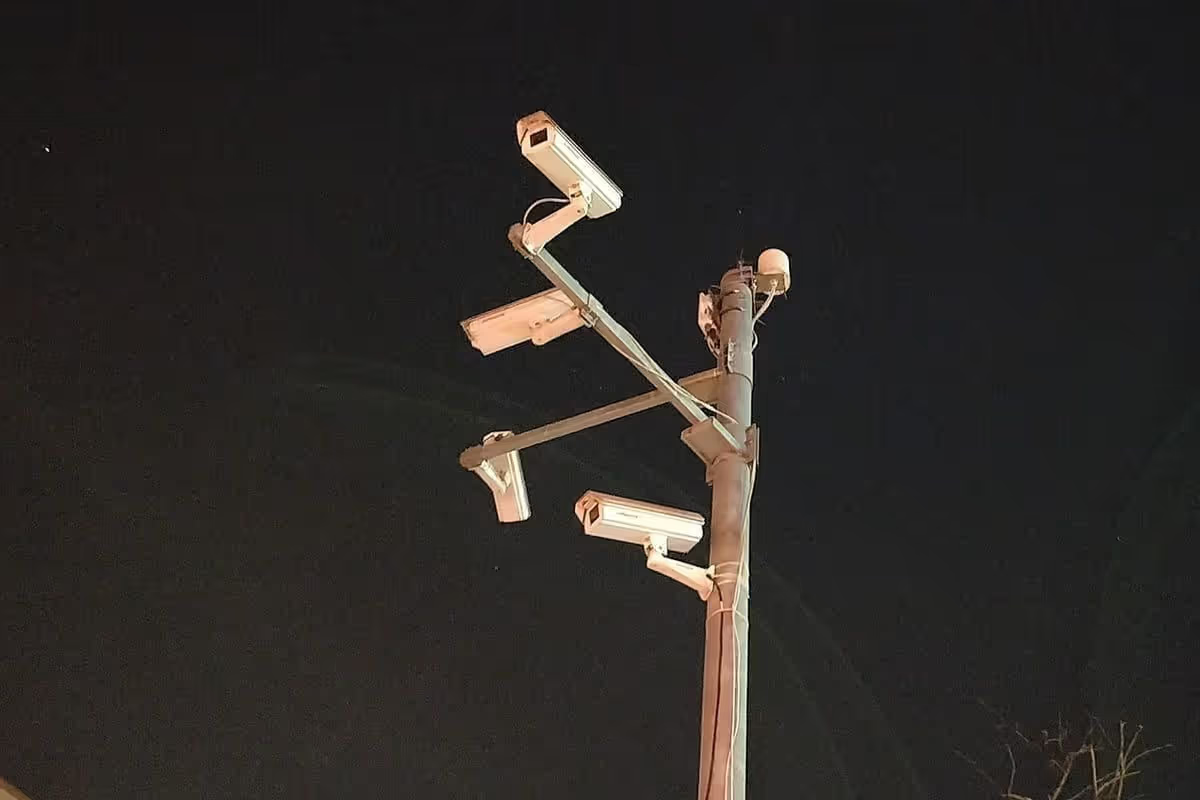
Fixed surveillance cameras mounted on a pole against an open sky

The six variables

What actually determines capture quality

In rough order of how often each one is the reason a deployment underperforms.

01

Pixels across the eyes at the capture point

The single most predictive measurement, and the ceiling on everything else. Measured where people stand, not at the centre of the frame. If this is too low, nothing downstream compensates.

What usually fixes it

Move the camera closer, narrow the lens, or move the capture point. A higher-resolution camera in the same position helps less than people expect, because the field of view usually grows with it.

02

Lighting direction and dynamic range

A glass entrance backlights everyone who walks in, and a silhouette carries no facial detail at any resolution. This is the most common cause of a system that worked in the demo and not in production.

What usually fixes it

Add front fill light, reposition the camera away from the bright background, or move the capture point deeper inside where the light is even. Usually cheaper than any camera change.

03

Angle between camera and face

A camera mounted high enough to be out of reach is often mounted high enough to see mostly the top of a head. Pose variation degrades matching more than most differences between algorithms.

What usually fixes it

Lower the camera, or move the capture point further from it so the downward angle flattens. A terminal at head height removes the problem entirely, which is why terminal deployments are easier.

04

Stream compression and frame rate

Compression removes exactly the fine texture detail matching depends on. A stream that looks fine to a human viewer can be well below what recognition needs.

What usually fixes it

Give the analytics a higher-quality second stream profile where the camera supports one. Often the cheapest single improvement available, and it costs nothing in hardware.

05

Subject movement and exposure

Motion blur is a function of shutter speed, and shutter speed is a function of available light. A corridor that works in daylight can fail at night with the same camera and the same people.

What usually fixes it

More light allows a faster shutter. Alternatively, choose a capture point where people naturally slow — a door, a gate, a turnstile — rather than mid-stride in a corridor.

06

Where people look

People approaching a door look at the door, at their phone, or at the person beside them. A camera placed where nobody looks captures a lot of profiles and ears.

What usually fixes it

Put the camera where attention already is. A screen, a signal light or the door itself draws the face towards the lens without asking anyone to do anything.

By environment

Where to put the camera, by capture point

The geometry problem changes shape depending on what people are doing when they pass. These are the patterns that recur.

Typical capture points, the geometry problem each presents, and the arrangement that usually works.
Capture point The problem What usually works
Office entrance with glass frontage Everyone is backlit; exposure chases the bright background. Capture deeper inside, away from the glass, with even front light. A terminal at the door beats a ceiling camera.
Turnstile or speed gate People are moving and the aperture is narrow. Camera at head height in the lane, capturing during the approach rather than at the barrier.
Reception desk Variable standing position and distance. A terminal or fixed camera at a defined position, which removes the variability entirely.
Corridor People are mid-stride, looking ahead, at varying distances. Capture at a natural pause — a door, a stair head, a lift lobby — rather than mid-corridor.
Concourse or open area Uncontrolled distance, pose and lighting; many faces at once. Accept a lower capture rate, gate hard on quality, and place cameras at natural choke points.
Gate or eGate Height distribution across the whole population. Design capture for the range rather than the mean, with a second camera or an assisted lane for the tails.

Camera survey checklist

Take these measurements before specifying anything. It costs a morning per site and it prevents the most expensive category of mistake in this field.

  1. Stand where a person stands and capture a still

    From the existing camera, at the exact position where the decision has to be made. Not a nearby position, and not the centre of the frame.

  2. Measure pixels across the eyes on that still

    This is the number that bounds everything. Record it per capture point, because it varies more between points than people expect.

  3. Repeat at the worst hour of the day

    Winter morning, summer afternoon, and after dark if the site operates then. A survey at the convenient hour measures a building that only exists at that hour.

  4. Note the light source relative to the face

    Front, side or behind. Behind is the problem, and it is usually structural — a glass frontage — rather than a fitting that can be swapped.

  5. Measure the downward angle to the face

    From the camera to the capture point. The shallower the better; record it so the trade against mounting height is made deliberately.

  6. Check the stream profile the analytics will receive

    Resolution, frame rate and compression, not what the camera is capable of. A second, higher-quality stream profile is often available and unused.

  7. Observe where people actually look

    Watch for ten minutes at a busy time. People look at doors, screens and each other. Put the camera where attention already goes.

  8. Note walking speed at the capture point

    And whether there is a natural pause nearby. A pause is worth more than a camera upgrade, and it is usually free.

  9. Record the height range that must be served

    Including children and wheelchair users where they are in scope. The tails of that distribution generate the exception rate.

  10. Have a representative clip assessed before buying

    Thirty seconds from the real camera at the real time of day answers the question definitively. It is faster and cheaper than any specification exercise.

Download the camera planning guide

Honesty

What good camera placement cannot fix

Worth stating, because a guide that implies placement solves everything sets up its reader for a surprise.

A mismatched enrolment process

If people were enrolled under conditions the site never reproduces — a bright meeting room, a different camera, a different angle — every later comparison inherits the mismatch. Enrolment quality is the other ceiling, and it is independent of placement.

A threshold set for the wrong cost balance

Perfect capture at a threshold chosen without reference to what each error costs at that door produces confident wrong answers. Placement improves the input; it does not choose the operating point.

A gallery that has outgrown the error rate

1:N error rates rise with gallery size. A system that worked at two thousand enrolments and struggles at fifty thousand has a scale problem, not a camera problem.

A purpose that was never narrow enough

No camera arrangement makes an ill-defined deployment defensible. If the purpose cannot be stated in one testable sentence, the placement question is premature.

A missing fallback path

Some people will not be recognised, however good the capture. What happens to them is a process design question that placement does not touch, and it usually dominates the staffing cost.

Demographic performance differences

Better capture helps everyone, including groups the system serves worse — but it does not by itself equalise performance. That has to be measured at the deployment and acted on separately.

Frequently asked questions

How many pixels does face recognition need across a face?

More than most people assume, and the number that matters is measured across the eyes at the point people actually pass — not the frame width, and not at the centre of the view. Rather than quoting a threshold that would be wrong for some combination of algorithm, lighting and pose, the reliable method is to capture a still from the real position, measure the pixels across the eyes, and assess that image. It takes a morning and it settles the question definitively for your site.

Can I use my existing CCTV cameras for face recognition?

Sometimes, and the answer comes from measurement rather than from the specification sheet. A camera positioned for scene coverage — wide, high, angled down — usually sees the top of heads. A camera positioned for faces sees faces. The distinction is about placement and lens choice far more than about the camera model, which is why an existing estate often needs a few cameras added rather than all of them replaced.

What is the best camera height for face recognition?

Low enough that the angle to the face is shallow, high enough to be out of reach and out of the way. That tension is real and should be resolved deliberately rather than by defaulting to the mounting height used for general surveillance. A camera at head height at the point of capture gives the best geometry; where that is impossible, a smaller downward angle is better than a larger one, and the capture point can often be moved closer to the camera instead.

Does lighting matter more than camera resolution?

Frequently, yes. A glass entrance backlights everyone who walks through it, and no amount of resolution recovers a silhouetted face. Lighting problems are usually cheaper to fix than camera problems — a light fitting, a repositioned camera, a change of capture point — provided they are identified during the survey rather than after go-live.

What does stream compression do to face recognition?

It removes exactly the fine detail matching depends on. A stream that looks perfectly acceptable to a person watching it can be well below what recognition needs, because human viewers tolerate compression artefacts that destroy the texture information an algorithm uses. Where a camera supports a second stream profile, giving the analytics a higher-quality one is often the cheapest single improvement available.

How fast can someone be moving and still be recognised?

That depends on the exposure time, the frame rate and the lighting far more than on the algorithm. Motion blur at a given walking speed is a function of shutter speed, and shutter speed is a function of available light. This is why a corridor that works in daylight can fail at night with the same camera and the same people — and why the survey has to happen at the worst hour, not the convenient one.

What can good camera placement not fix?

Several things worth knowing in advance. It cannot fix an enrolment process that captured people under conditions the site will never reproduce. It cannot fix a threshold set for the wrong cost balance. It cannot fix a gallery that has grown past what the error rate tolerates. And it cannot fix a deployment whose purpose was never narrow enough to test. Placement is necessary and not sufficient.